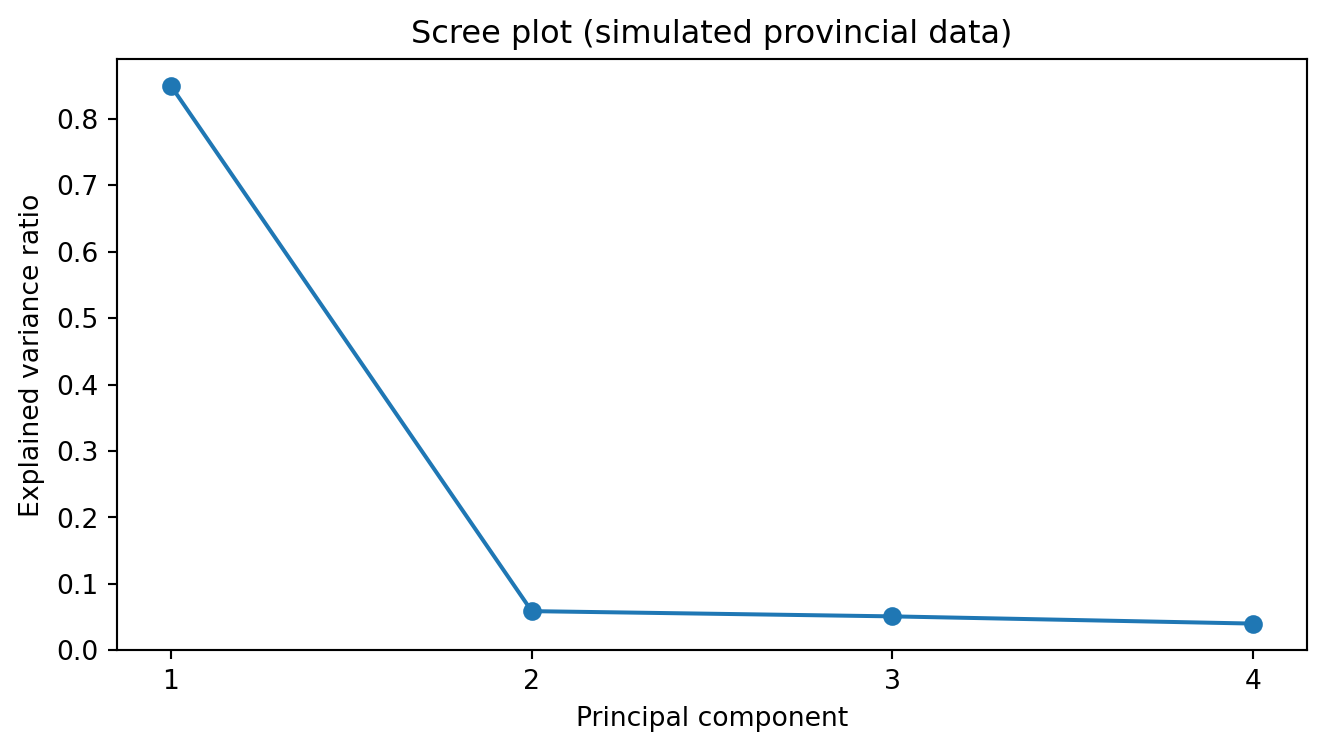
PCA ช่วยย่อข้อมูลเศรษฐกิจจำนวนมากให้เหลือองค์ประกอบไม่กี่มิติผ่านการใช้โครงสร้างความแปรปรวนร่วม การแปลผลต้องพิจารณาการปรับมาตรฐาน น้ำหนักของตัวแปร explained variance และการกลับเครื่องหมายประกอบเสมอ การสร้างดัชนีเศรษฐกิจจาก PCA ยังต้องอาศัยกรอบทฤษฎีเศรษฐศาสตร์ การเลือกตัวชี้วัด และการวิเคราะห์ความไว ขณะที่ t-SNE และ UMAP ควรใช้เพื่อการสำรวจและแสดงภาพเป็นหลัก ไม่ใช่เครื่องมือให้ข้อสรุปเชิงสาเหตุหรือมาตรวัดเชิงนโยบายโดยตรง
Agrawal, Rakesh, และ Ramakrishnan Srikant. 1994.
“Fast Algorithms for Mining Association Rules in Large Databases”.
Proceedings of the 20th International Conference on Very Large Data Bases, 487–99.
https://www.vldb.org/dblp/db/conf/vldb/vldb94-487.html.
Athey, Susan, และ Guido W. Imbens. 2019.
“Machine Learning Methods That Economists Should Know About”.
Annual Review of Economics 11: 685–725.
https://doi.org/10.1146/annurev-economics-080217-053433.
Bergmeir, Christoph, Rob J. Hyndman, และ Bonsoo Koo. 2018.
“A Note on the Validity of Cross-Validation for Evaluating Autoregressive Time Series Prediction”.
Computational Statistics & Data Analysis 120: 70–83.
https://doi.org/10.1016/j.csda.2017.11.003.
Bishop, Christopher M. 2006. Pattern Recognition and Machine Learning. Springer.
Breiman, Leo. 1996.
“Bagging Predictors”.
Machine Learning 24: 123–40.
https://doi.org/10.1007/BF00058655.
Breiman, Leo. 2001.
“Random Forests”.
Machine Learning 45: 5–32.
https://doi.org/10.1023/A:1010933404324.
Breunig, Markus M., Hans-Peter Kriegel, Raymond T. Ng, และ Jörg Sander. 2000.
“LOF: Identifying Density-Based Local Outliers”.
ACM SIGMOD Record 29 (2): 93–104.
https://doi.org/10.1145/335191.335388.
Brier, Glenn W. 1950.
“Verification of Forecasts Expressed in Terms of Probability”.
Monthly Weather Review 78 (1): 1–3.
https://doi.org/10.1175/1520-0493(1950)078<0001:VOFEIT>2.0.CO;2.
Broman, Karl W., และ Kara H. Woo. 2018.
“Data Organization in Spreadsheets”.
The American Statistician 72 (1): 2–10.
https://doi.org/10.1080/00031305.2017.1375989.
Chandola, Varun, Arindam Banerjee, และ Vipin Kumar. 2009.
“Anomaly Detection: A Survey”.
ACM Computing Surveys 41 (3): 15:1–58.
https://doi.org/10.1145/1541880.1541882.
Chen, Tianqi, และ Carlos Guestrin. 2016.
“XGBoost: A Scalable Tree Boosting System”.
Proceedings of the 22nd ACM SIGKDD International Conference on Knowledge Discovery and Data Mining, 785–94.
https://doi.org/10.1145/2939672.2939785.
Chernozhukov, Victor, Denis Chetverikov, Mert Demirer, และคณะ. 2018.
“Double/Debiased Machine Learning for Treatment and Structural Parameters”.
The Econometrics Journal 21 (1): C1–68.
https://doi.org/10.1111/ectj.12097.
Cleveland, William S., และ Robert McGill. 1984.
“Graphical Perception: Theory, Experimentation, and Application to the Development of Graphical Methods”.
Journal of the American Statistical Association 79 (387): 531–54.
https://doi.org/10.1080/01621459.1984.10478080.
Croushore, Dean. 2011.
“Frontiers of Real-Time Data Analysis”.
Journal of Economic Literature 49 (1): 72–100.
https://doi.org/10.1257/jel.49.1.72.
Cunningham, Scott. 2021.
Causal Inference: The Mixtape. Yale University Press.
https://doi.org/10.2307/j.ctv1c29t27.
Davies, David L., และ Donald W. Bouldin. 1979.
“A Cluster Separation Measure”.
IEEE Transactions on Pattern Analysis and Machine Intelligence PAMI-1 (2): 224–27.
https://doi.org/10.1109/TPAMI.1979.4766909.
Diebold, Francis X., และ Roberto S. Mariano. 1995.
“Comparing Predictive Accuracy”.
Journal of Business & Economic Statistics 13 (3): 253–63.
https://doi.org/10.1080/07350015.1995.10524599.
Efron, Bradley, และ Robert J. Tibshirani. 1993. An Introduction to the Bootstrap. Chapman; Hall.
Ester, Martin, Hans-Peter Kriegel, Jörg Sander, และ Xiaowei Xu. 1996.
“A Density-Based Algorithm for Discovering Clusters in Large Spatial Databases with Noise”.
Proceedings of the Second International Conference on Knowledge Discovery and Data Mining, 226–31.
https://www.aaai.org/Papers/KDD/1996/KDD96-037.pdf.
Fawcett, Tom. 2006.
“An Introduction to ROC Analysis”.
Pattern Recognition Letters 27 (8): 861–74.
https://doi.org/10.1016/j.patrec.2005.10.010.
Federal Reserve Bank of St. Louis. ม.ป.ป.-a.
“ALFRED: Archival Federal Reserve Economic Data”. สืบค้น 25 ตุลาคม 2026.
https://fred.stlouisfed.org/docs/api/fred/alfred.html.
Federal Reserve Bank of St. Louis. ม.ป.ป.-b.
“ALFRED: Archival Federal Reserve Economic Data”. สืบค้น 28 ตุลาคม 2026.
https://alfred.stlouisfed.org/.
Federal Reserve Bank of St. Louis. ม.ป.ป.-c.
“FRED API Terms of Use”. สืบค้น 28 ตุลาคม 2026.
https://fred.stlouisfed.org/docs/api/terms_of_use.html.
Friedman, Jerome H. 2001.
“Greedy Function Approximation: A Gradient Boosting Machine”.
The Annals of Statistics 29 (5): 1189–232.
https://doi.org/10.1214/aos/1013203451.
Gapminder Foundation. ม.ป.ป.
Gapminder Data.
https://www.gapminder.org/data/.
Giannone, Domenico, Lucrezia Reichlin, และ David Small. 2008.
“Nowcasting: The Real-Time Informational Content of Macroeconomic Data”.
Journal of Monetary Economics 55 (4): 665–76.
https://doi.org/10.1016/j.jmoneco.2008.05.010.
Goldstein, Alex, Adam Kapelner, Justin Bleich, และ Emil Pitkin. 2015.
“Peeking Inside the Black Box: Visualizing Statistical Learning with Plots of Individual Conditional Expectation”.
Journal of Computational and Graphical Statistics 24 (1): 44–65.
https://doi.org/10.1080/10618600.2014.907095.
Hahsler, Michael, Bettina Grün, และ Kurt Hornik. 2005.
“arules – A Computational Environment for Mining Association Rules and Frequent Item Sets”.
Journal of Statistical Software 14 (15): 1–25.
https://doi.org/10.18637/jss.v014.i15.
Hastie, Trevor, Robert Tibshirani, และ Jerome Friedman. 2009.
The Elements of Statistical Learning: Data Mining, Inference, and Prediction. 2 พิมพ์ครั้งที่. Springer.
https://doi.org/10.1007/978-0-387-84858-7.
Hernán, Miguel A., และ James M. Robins. 2020.
Causal Inference: What If. Chapman; Hall/CRC.
https://miguelhernan.org/whatifbook.
Hoerl, Arthur E., และ Robert W. Kennard. 1970.
“Ridge Regression: Biased Estimation for Nonorthogonal Problems”.
Technometrics 12 (1): 55–67.
https://doi.org/10.1080/00401706.1970.10488634.
Hubert, Lawrence, และ Phipps Arabie. 1985.
“Comparing Partitions”.
Journal of Classification 2: 193–218.
https://doi.org/10.1007/BF01908075.
Hyndman, Rob J., และ George Athanasopoulos. 2021.
Forecasting: Principles and Practice. 3 พิมพ์ครั้งที่. OTexts.
https://otexts.com/fpp3/.
Hyndman, Rob J., และ Anne B. Koehler. 2006.
“Another look at measures of forecast accuracy”.
International Journal of Forecasting 22 (4): 679–88.
https://doi.org/10.1016/j.ijforecast.2006.03.001.
James, Gareth, Daniela Witten, Trevor Hastie, Robert Tibshirani, และ Jonathan Taylor. 2023.
An Introduction to Statistical Learning: With Applications in Python. Springer.
https://doi.org/10.1007/978-3-031-38747-0.
Jolliffe, Ian T., และ Jorge Cadima. 2016.
“Principal Component Analysis: A Review and Recent Developments”.
Philosophical Transactions of the Royal Society A: Mathematical, Physical and Engineering Sciences 374 (2065): 20150202.
https://doi.org/10.1098/rsta.2015.0202.
Kapoor, Sayash, และ Arvind Narayanan. 2023.
“Leakage and the Reproducibility Crisis in Machine-Learning-Based Science”.
Patterns 4 (9): 100804.
https://doi.org/10.1016/j.patter.2023.100804.
Kuhn, Max, และ Kjell Johnson. 2013.
Applied Predictive Modeling. Springer.
https://doi.org/10.1007/978-1-4614-6849-3.
Kuhn, Max, และ Kjell Johnson. 2019.
Feature Engineering and Selection: A Practical Approach for Predictive Models. CRC Press.
https://bookdown.org/max/FES/.
Little, Roderick J. A., และ Donald B. Rubin. 2019.
Statistical Analysis with Missing Data. 3 พิมพ์ครั้งที่. Wiley.
https://doi.org/10.1002/9781119482260.
Liu, Fei Tony, Kai Ming Ting, และ Zhi-Hua Zhou. 2008.
“Isolation Forest”.
Proceedings of the Eighth IEEE International Conference on Data Mining, 413–22.
https://doi.org/10.1109/ICDM.2008.17.
Lloyd, Stuart P. 1982.
“Least Squares Quantization in PCM”.
IEEE Transactions on Information Theory 28 (2): 129–37.
https://doi.org/10.1109/TIT.1982.1056489.
Lundberg, Scott M., และ Su-In Lee. 2017.
“A Unified Approach to Interpreting Model Predictions”.
Advances in Neural Information Processing Systems 30.
https://papers.neurips.cc/paper/7062-a-unified-approach-to-interpreting-model-predictions.
Maaten, Laurens van der, และ Geoffrey Hinton. 2008.
“Visualizing Data Using t-SNE”.
Journal of Machine Learning Research 9: 2579–605.
https://jmlr.org/papers/v9/vandermaaten08a.html.
McInnes, Leland, John Healy, และ James Melville. 2018.
UMAP: Uniform Manifold Approximation and Projection for Dimension Reduction.
https://doi.org/10.48550/arXiv.1802.03426.
Mitchell, Margaret, Simone Wu, Andrew Zaldivar, และคณะ. 2019.
“Model Cards for Model Reporting”.
Proceedings of the Conference on Fairness, Accountability, and Transparency, 220–29.
https://doi.org/10.1145/3287560.3287596.
Molnar, Christoph. 2022.
Interpretable Machine Learning: A Guide for Making Black Box Models Explainable. 2 พิมพ์ครั้งที่. Christoph Molnar.
https://christophmolnar.com/books/interpretable-machine-learning.
Mullainathan, Sendhil, และ Jann Spiess. 2017.
“Machine Learning: An Applied Econometric Approach”.
Journal of Economic Perspectives 31 (2): 87–106.
https://doi.org/10.1257/jep.31.2.87.
Niculescu-Mizil, Alexandru, และ Rich Caruana. 2005.
“Predicting Good Probabilities with Supervised Learning”.
Proceedings of the 22nd International Conference on Machine Learning, 625–32.
https://doi.org/10.1145/1102351.1102430.
Nosek, Brian A. และคณะ. 2015.
“Promoting an Open Research Culture”.
Science 348 (6242): 1422–25.
https://doi.org/10.1126/science.aab2374.
OECD, European Union, และ European Commission, Joint Research Centre. 2008.
Handbook on Constructing Composite Indicators: Methodology and User Guide. OECD Publishing.
https://doi.org/10.1787/9789264043466-en.
Pedregosa, Fabian, Gael Varoquaux, Alexandre Gramfort, และคณะ. 2011.
“Scikit-learn: Machine Learning in Python”.
Journal of Machine Learning Research 12: 2825–30.
https://jmlr.org/papers/v12/pedregosa11a.html.
Peng, Roger D. 2011.
“Reproducible Research in Computational Science”.
Science 334 (6060): 1226–27.
https://doi.org/10.1126/science.1213847.
Plotly Technologies Inc. ม.ป.ป.
Built-in Datasets in Plotly Express: Gapminder.
https://plotly.com/python-api-reference/generated/plotly.express.data.html.
Quarto. ม.ป.ป.
“Using Python”. สืบค้น 25 ตุลาคม 2026.
https://quarto.org/docs/computations/python.html.
Roberts, David R., Volker Bahn, Simone Ciuti, และคณะ. 2017.
“Cross-validation strategies for data with temporal, spatial, hierarchical, or phylogenetic structure”.
Ecography 40 (8): 913–29.
https://doi.org/10.1111/ecog.02881.
Rosenbaum, Paul R., และ Donald B. Rubin. 1983.
“The Central Role of the Propensity Score in Observational Studies for Causal Effects”.
Biometrika 70 (1): 41–55.
https://doi.org/10.1093/biomet/70.1.41.
Rousseeuw, Peter J. 1987.
“Silhouettes: A Graphical Aid to the Interpretation and Validation of Cluster Analysis”.
Journal of Computational and Applied Mathematics 20: 53–65.
https://doi.org/10.1016/0377-0427(87)90125-7.
Sandve, Geir Kjetil, Anton Nekrutenko, James Taylor, และ Eivind Hovig. 2013.
“Ten Simple Rules for Reproducible Computational Research”.
PLOS Computational Biology 9 (10): e1003285.
https://doi.org/10.1371/journal.pcbi.1003285.
scikit-learn developers. ม.ป.ป.-b.
“Common Pitfalls and Recommended Practices”. สืบค้น 25 ตุลาคม 2026.
https://scikit-learn.org/stable/common_pitfalls.html.
scikit-learn developers. ม.ป.ป.-c.
“Cross-validation: Evaluating Estimator Performance”. สืบค้น 25 ตุลาคม 2026.
https://scikit-learn.org/stable/modules/cross_validation.html.
scikit-learn developers. ม.ป.ป.-e.
“Pipeline: Chaining Estimators”. สืบค้น 28 ตุลาคม 2026.
https://scikit-learn.org/stable/modules/compose.html#pipeline-chaining-estimators.
Stock, James H., และ Mark W. Watson. 2002.
“Macroeconomic Forecasting Using Diffusion Indexes”.
Journal of Business & Economic Statistics 20 (2): 147–62.
https://doi.org/10.1198/073500102317351921.
Tibshirani, Robert. 1996.
“Regression Shrinkage and Selection via the Lasso”.
Journal of the Royal Statistical Society: Series B (Methodological) 58 (1): 267–88.
https://doi.org/10.1111/j.2517-6161.1996.tb02080.x.
Varian, Hal R. 2014.
“Big Data: New Tricks for Econometrics”.
Journal of Economic Perspectives 28 (2): 3–28.
https://doi.org/10.1257/jep.28.2.3.
Varma, Sudhir, และ Richard Simon. 2006.
“Bias in error estimation when using cross-validation for model selection”.
BMC Bioinformatics 7: 91.
https://doi.org/10.1186/1471-2105-7-91.
Ward, Joe H. 1963.
“Hierarchical Grouping to Optimize an Objective Function”.
Journal of the American Statistical Association 58 (301): 236–44.
https://doi.org/10.1080/01621459.1963.10500845.
Waskom, Michael L. 2021.
“seaborn: Statistical Data Visualization”.
Journal of Open Source Software 6 (60): 3021.
https://doi.org/10.21105/joss.03021.
Wickham, Hadley. 2014.
“Tidy Data”.
Journal of Statistical Software 59 (10): 1–23.
https://doi.org/10.18637/jss.v059.i10.
Wilkinson, Mark D. และคณะ. 2016.
“The FAIR Guiding Principles for Scientific Data Management and Stewardship”.
Scientific Data 3: 160018.
https://doi.org/10.1038/sdata.2016.18.
Wilson, Greg, Jennifer Bryan, Karen Cranston, Justin Kitzes, Lex Nederbragt, และ Tracy K. Teal. 2017.
“Good Enough Practices in Scientific Computing”.
PLOS Computational Biology 13 (6): e1005510.
https://doi.org/10.1371/journal.pcbi.1005510.
World Bank. ม.ป.ป.-a.
“About the Indicators API Documentation”. สืบค้น 25 ตุลาคม 2026.
https://datahelpdesk.worldbank.org/knowledgebase/articles/889392.
Zou, Hui, และ Trevor Hastie. 2005.
“Regularization and Variable Selection via the Elastic Net”.
Journal of the Royal Statistical Society: Series B (Statistical Methodology) 67 (2): 301–20.
https://doi.org/10.1111/j.1467-9868.2005.00503.x.